

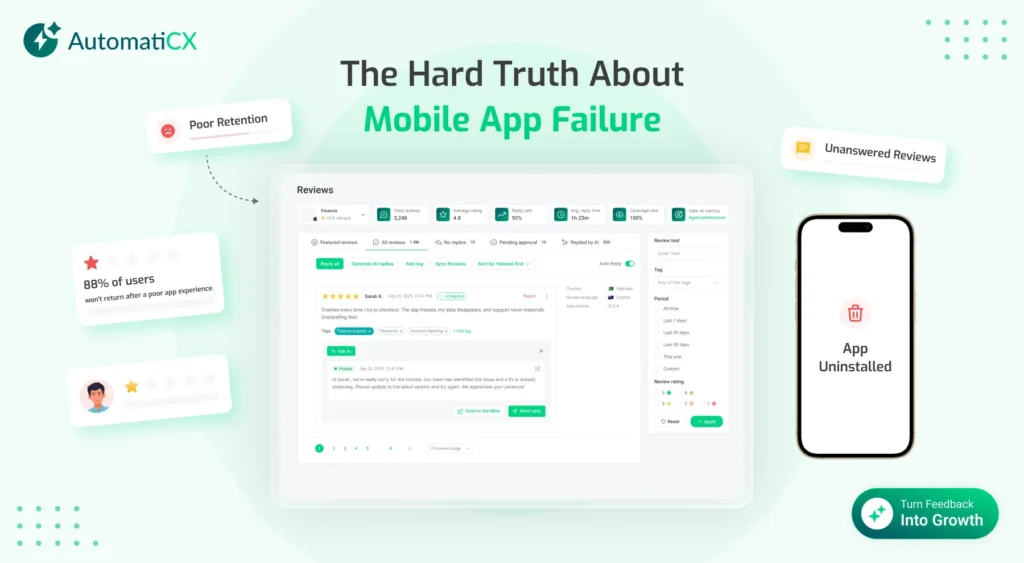
Upto 90% of the mobile apps fail to gain meaningful attraction of the users, instead of thousands of downloads. It is a staggering reality for founders and growth teams at the same time.
The digital ecosystem is hard and brutal. There are millions of applications in the marketplaces, and they are fighting for the user’s attention spans. A few years ago, getting user attention for downloads and app installation used to be a hard part but now real challenges begin after downloads.
If you run your growth strategy using outdated playbooks, you are burning capital. Paid acquisition channels are overcrowded, data privacy changes have disrupted traditional ad targeting, and modern users demand instant value. To win, you must look at your product through a new lens.
This guide will draw your attention to the best mobile app growth operating system for 2026. This also tells you how you can combine the data-backed organic discovery advance user retention loops, and automated artificial intelligence tools can turn your app to invisible storefront into scalable growth.
Section 1: What Is Mobile App Growth?
True mobile app growth is not a single department or a solo ad campaign. It is a continuous process that connects product performance, marketing strategies, and user data. It evaluates how effectively your app increases its customer base while driving long-term revenue.
To scale properly, a growth team must focus on five core pillars:
Downloads: Securing fresh, high-intent users through search and paid media.
Active Users: Getting people to open and use your app regularly.
Engagement: Designing meaningful features that keep users interactive.
Retention: Keeping customers on your platform for months or years instead of days.
Revenue: Converting that active engagement into stable monetization.
The Modern App Growth Funnel
To visualize this pipeline, top marketing teams rely on a structured, multi-stage funnel framework. This map traces a user’s entire life cycle with your product:
Understanding this framework helps you diagnose exactly where your application is losing money. If your awareness metrics are massive but your activation numbers are flat, your app store listing is likely making promises that your onboarding flow fails to deliver.
Section 2: Why Traditional App Growth Strategies No Longer Work
The marketing strategies that scaled apps five years ago are actively failing today. Relying purely on legacy playbooks is an easy way to stall your product’s growth.
Rising Cost Per Install (CPI)
Paid user acquisition is getting more expensive day by day. As there are privacy restrictions for both iOS and Android, ad networks can no longer track users with perfect precision. Due to this, you have to spend more money to reach the same number of high-value accounts.
Extreme Market Saturation
The app marketplaces are completely flooded. There is a mobile tool for almost every human task imaginable. Standing out in a sea of identical products requires a level of contextual discovery that basic keyword adjustments can no longer provide.
Sky-High User Expectations
Modern consumers are prone to frustration over friction. They expect superfast onboarding, instant app response times and a fast value proposition. If they are facing a confusing menu or a forced registration wall during their first session, they are more likely to leave you and download another app.
Manual Data Overload
A typical mobile app generates millions of data points every day and they include event logs, storefront clicks and user reviews. Human marketing teams simply cannot parse this mountain of data quickly enough to make real-time optimizations.
This data paralysis is exactly where artificial intelligence changes the game.
Section 3: How AI Is Revolutionizing Mobile App Growth
Artificial intelligence has shifted from an experimental feature to the absolute foundation of modern App Marketing Solutions. It acts as the intelligent infrastructure that turns raw data into automated growth.
Artificial intelligence has shifted from an experimental feature to the foundation of modern app Marketing Solutions. It acts as the great infrastructure that streamlines the raw data into automated growth data.
Programmatic User Acquisition
Instead of manual ad placements, growth teams can deploy predictive data models to run campaigns. These automated systems analyze real-time behavioral data to optimize audience targeting, project lifetime value, and automatically build high-converting lookalike audiences across all major ad platforms.
Data-Driven Personalization at Scale
Modern applications can adjust dynamically based on individual user activity. By analyzing structural behavioral patterns, an advanced optimization platform can alter interface layouts, update product recommendations, and tailor the in-app experience to match a user’s exact preferences.
Automated Engagement Mechanics
Systematic workflows keep users active without requiring constant manual oversight. Built-in interactive assistants and smart conversational interfaces guide users through complex setups, provide instant customer support, and serve timely recommendations exactly when they are needed most.
Section 4: Advanced App Store Optimization (ASO)
App Store Optimization remains your strongest asset for driving organic growth. However, traditional, manual keyword tracking is simply too slow to keep pace in today’s landscape. High-performance teams rely on programmatic ASO systems to capture high-intent organic traffic on autopilot.
Automated Search Discoverability
Data-driven platforms crawl millions of search combinations daily to spot emerging market trends. These systems isolate high-volume keywords with low competitive difficulty, allowing you to index for rising search terms weeks before competitors notice the shift.
Listing Copy Optimization
Dynamic optimization systems can draft, format, and adjust your store metadata—including your App Title, Subtitle, and Short Description. The software uses linguistic processing to ensure your text matches platform indexing requirements perfectly while remaining highly persuasive to human readers.
Creative Asset Analytics
Visuals drive downloads. Algorithmic testing frameworks run continuous multi-variant experiments on your icons, app screenshots, and preview videos. By analyzing real-time click-through patterns, the system automatically surfaces the exact visual variations that generate the highest install conversions.
Section 5: User Acquisition Strategies That Scale
A resilient brand requires a balanced mix of multiple distribution channels. Diversifying your acquisition ensures your business is not dependent on a single channel’s algorithm.
Organic Acquisition Channels
App Store Optimization (ASO): The foundational engine for steady, zero-cost user acquisition.
Content Marketing & SEO: Building high-value web articles that address user pain points and route desktop searchers directly to your app storefront.
Social Media Engineering: Crafting organic, short-form video content on platforms like TikTok and Instagram to drive viral traffic loops to your download pages.
Paid Acquisition Engines
Intent-Based Search Ads: Deploying Apple Search Ads and Google App Campaigns to position your product directly above competitors when users type in specific high-intent search terms.
Paid Social Media: Scaling visual video assets across Meta, TikTok, and YouTube to capture broad demographics.
Influencer Partnerships: Collaborating with contextual creators who already hold deep trust with your exact target audience to drive high-converting product recommendations.
Double-Sided Referral Ecosystems
Word-of-mouth remains an incredibly powerful acquisition tool. Setting up in-app referral programs that reward both the sender and the receiver creates an organic, self-sustaining loop that lowers your overall acquisition costs.
Section 6: Retention Optimization Using AI
Acquiring a user means nothing if your churn velocity is higher than your install rate. In 2026, retention is the truest indicator of long-term financial success.
Predictive Churn Analysis
Machine learning algorithms analyze historic usage patterns to flag accounts that are losing interest. If a user starts opening the app less frequently or runs into repeated usage friction, the predictive engine registers this risk and immediately deploys automated win-back strategies before the user removes the app entirely.
Optimized Push Notifications
Generic notification blasts irritate users and lead to notifications being turned off. AI schedules and tailors your push outreach for each user. It determines the exact minute a person is most likely to open their device and serves a customized message based on their real-time history.
Adaptive Onboarding Flows
Not every user installs your app for the same reason. An intelligent onboarding engine identifies a user’s specific goals within their first three taps. It adjusts the setup walkthrough dynamically, ensuring the user hits their specific “aha!” moment as quickly as possible.
Section 7: App Reviews & Reputation Management
Your storefront’s public rating is a critical conversion factor. It directly influences your app store rankings, search authority, and whether a browser feels safe hitting the download button.
The Impact of Social Proof
When users see a low rating on an app page, they don’t read the descriptions; they just leave. Managing your public feedback is an absolute necessity for modern App Reputation Management.
Furthermore, app store search engines crawl your review text for keywords. If your app regularly receives reviews containing natural, high-intent phrases, your product earns a natural organic ranking boost for those terms.
AI Feedback Analytics and Sentiment Analysis
Review volumes can quickly scale beyond what a manual support team can handle. By running continuous AI Feedback Analytics, a machine learning core scans every incoming review to track user sentiment.
The system automatically detects the user’s emotions or feature requests into organized data clusters. This gives your engineering team a direct at product issues before they cause the reputational damage due to negative reviews.
AI Review Response Automation
Answering customer issues quickly can turn an angry user into a loyal promoter. Utilizing an AI Review Response Generator allows you to manage public feedback at scale without draining internal resources.
The software interprets the customer’s exact issue, creates a helpful response in your distinct brand voice, and publishes it automatically. It addresses negative feedback instantly while freeing up your human team to focus on major engineering fixes.
Section 8: Key Metrics Every Growth Team Should Track
To scale efficiently, you must cut through the vanity numbers and track the core data points that define your actual performance.
Metric | What It Evaluates | Strategic Value |
DAU / MAU | Daily Active Users divided by Monthly Active Users. | Measures your product’s overall stickiness and day-to-day user habits. |
Retention Rate | The percentage of users who remain active after Day 1, 7, and 30. | The ultimate test of your product-market fit and onboarding quality. |
Churn Rate | The percentage of your active customer base that abandons your app. | Flags technical issues, poor feature updates, or user frustration points. |
Customer Lifetime Value (LTV) | The total revenue an individual user generates over their lifetime. | Sets the absolute ceiling for how much your marketing team can spend on ads. |
Customer Acquisition Cost (CAC) | Total marketing spend divided by total newly acquired users. | Must remain significantly lower than LTV to build a profitable business. |
Average Revenue Per User (ARPU) | Total revenue divided by your total number of active users. | Evaluates the monetization efficiency of your core features. |
Future Trends: Mobile App Growth in the AI Era
The mobile landscape continues to evolve rapidly. To protect your market share, your growth strategy must account for these emerging trends:
Voice and Natural Language Discovery
As conversational AI engines integrate directly into mobile operating systems, users are shifting away from traditional short-phrase typing. Store optimization will require adjusting metadata to rank for full-sentence voice commands and natural user questions.
AI-Generated Asset Variation
The future of asset testing relies on real-time generation. Advanced optimization systems will automatically create unique screenshot variants, layouts, and ad copy tailored for specific users on the fly, maximizing conversion rates on a scale human teams cannot match.
Conclusion
Successful mobile app growth is not just about getting the maximum installs but it is all about building that ecosystem where every part of your funnel supports the next one.
Paying attention to stabilizing your foundations is the greatest thing that every business can do. Just clear out the onboarding friction and keep an eye on the product metrics as well as implement the automated tools to protect your storefront health.
If you are looking to bypass the manual overhead from your scaling efforts, AutomatiCX.ai is the tool that helps users to deploy advanced AI automation to run their review and reputation management. Let’s protect your app ecosystem.