

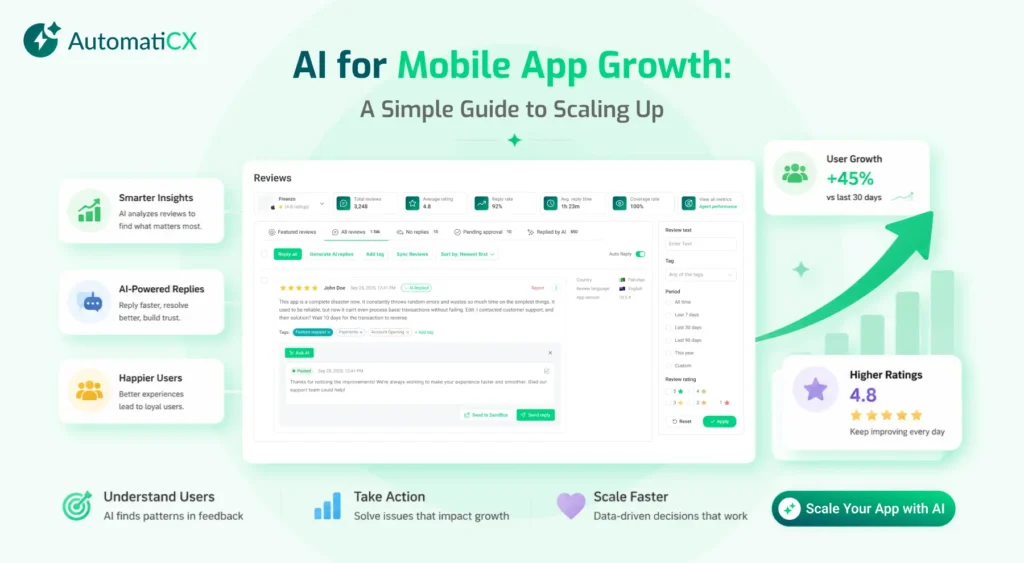
The Ultimate Guide to AI for Mobile App Growth
What is AI for mobile app growth? It is the strategic use of machine learning algorithms and natural language processing to automate user acquisition, optimize app store visibility, and predict when users will churn. By processing massive datasets instantly, AI platforms allow developers to shift from reactive troubleshooting to proactive, data-driven scaling.
Let’s be completely blunt. The days of manual “growth hacking” are over. You can no longer just tweak your app store screenshots, send out a generic push notification, and expect your daily active users to skyrocket.
The mobile market is too saturated. User acquisition costs are aggressively high. If you want to survive, let alone scale, you have to operate faster and smarter than the competition. You need a system that can analyze millions of data points, read thousands of user reviews, and adjust your marketing bids in real-time.
This is exactly where artificial intelligence takes over. We aren’t talking about generic chatbot fluff. We are talking about complex, statistical pattern recognition that saves your team hundreds of hours and drives actual revenue.
1. The Shift to Machine Learning for Mobile Apps
Ten years ago, app growth was a guessing game. Marketing teams would run an ad, wait three weeks, look at a spreadsheet, and try to guess why users were leaving. It was slow, expensive, and incredibly inefficient.
Today, integrating machine learning for mobile apps allows developers to automate the heavy lifting. Instead of humans looking at past data to see what went wrong, machine learning models look at current behavior to predict what will happen next.
These models ingest massive amounts of raw data screen taps, session lengths, feature usage, and uninstalls. They look for hidden correlations that a human analyst would never spot. For example, an AI model might notice that users who skip the second screen of your onboarding flow are 80% more likely to delete your app within three days. Armed with that data, your product team knows exactly what needs to be fixed.
2. Mastering Visibility with AI-Powered ASO
App Store Optimization (ASO) used to be a highly manual process of stuffing keywords into your title and hoping the Apple or Google algorithms noticed you. That tactic is dead. To capture high-intent users today, modern growth teams rely on AI-Powered ASO to predict search algorithm shifts before they happen.
The algorithms powering the App Store and Google Play are incredibly sophisticated. They don’t just look at words; they look at search intent, keyword density, and download velocity.
An AI-driven ASO strategy tackles this on several fronts:
Predictive Keyword Ranking: Instead of just showing you what keywords are popular today, AI tools forecast search volume trends based on seasonality and emerging pop culture topics.
Automated Feature Extraction: AI scans your competitors’ product pages, extracting the exact phrases and features their users are searching for, allowing you to counter-position your own app.
Dynamic Creative Testing: AI algorithms run rapid A/B tests on your icons and screenshots, funneling your ad budget toward the variations that yield the highest conversion rates without requiring a human to manually toggle the campaigns.
3. Decoding User Voice: AI Sentiment & Feedback Analysis
Once users download your app, they are going to talk about it. They will leave reviews on the App Store, complain on Twitter, and submit support tickets. If you have 10,000 active users, it is physically impossible for your product team to read every single comment.
This is where Natural Language Processing (NLP) changes the game.
Uncovering Trends with AI Customer Feedback Analysis
Utilizing AI customer feedback analysis alongside real-time data ingestion ensures that you never miss a critical bug report. Large Language Models (LLMs) can read thousands of reviews in seconds. They don’t just count words; they understand context.
If fifty people complain that “the checkout screen freezes when I use Apple Pay,” the AI flags this immediately and categorizes it as a high-priority bug, sending an alert straight to your engineering team’s Slack channel.
Quantifying Emotion via AI Sentiment Analysis
AI doesn’t just read the text; it feels the temperature of the room. By running AI sentiment analysis, you can assign a mathematical score to human emotion.
Behind the scenes, these tools use complex weighted formulas to prioritize severe issues over minor feature requests. The system calculates a weighted sentiment score ($S_{w}$) using Bayesian logic or a weighted sum approach:
In simple terms, the AI assigns a weight ($w_i$) to specific extracted features. A crash report gets a massive negative weight, while a request for “dark mode” gets a minor neutral weight. Centralizing your raw text data into a dedicated AI feedback analytics tool turns chaotic human opinions into a prioritized product roadmap.
4. Automating App Reputation Management
Your app’s star rating is your digital currency. If your rating drops below 4.0 stars, your cost per install (CPI) will skyrocket, and organic downloads will completely dry up. Most users won’t even click on an app with 3.5 stars, regardless of how good the ad was.
Protecting this score is the core of enterprise-grade App Reputation Management.
Streamlining Workflows with AI Review Management
Users expect to be heard. When someone leaves a 1-star review because they are frustrated, ignoring them is the worst thing you can do. A robust AI review management protocol monitors your incoming reviews 24/7. It categorizes them by language, app version, device type, and urgency.
Scaling Engagement via AI Review Response Automation
You need to reply to reviews, but writing custom replies to 500 reviews a day is a waste of human capital. Here is how modern teams handle it using AI review response automation:
1. Ingestion and Triage: Real-time scanning.
The system detects a new 2-star review complaining about a login error. It immediately tags the review as a “Technical Issue.”
2. Algorithmic Drafting: Contextual generation.
Teams deploy an AI review response generator that reads the user’s specific complaint. It drafts a polite, empathetic apology that specifically mentions the login error, avoiding generic “Thanks for your feedback” templates.
3. Human-in-the-Loop or Auto-Publish: Routing.
If the review is highly critical or from a high-value user, it is routed to a human for one-click approval. If it is a standard complaint, the AI publishes the response automatically.
4. The Rating Reversal: Follow-up.
Once the engineering team pushes an update fixing the login issue, the AI automatically follows up with the user, asking them to consider updating their 2-star rating to a 5-star rating.
5. Unlocking the Future: Predictive App Analytics
Looking at a dashboard to see how many people uninstalled your app yesterday is reactive. It tells you what you lost, but it doesn’t help you save the revenue.
Transitioning to predictive app analytics generates profound AI growth insights that allow you to see the future. Instead of reporting on the past, predictive AI tells you what your users are going to do next week.
Algorithmic Churn Prediction
Machine learning models study the exact behavior of users who have historically deleted your app. They map out the behavioral footprints like a drop in session frequency, disabling push notifications, or failing to complete a core action.
The AI then scans your current active users to see who is exhibiting those exact same footprints. It creates a “Churn Risk Score” for every single person in your database. If a highly profitable user enters the “High Risk” category, the AI can automatically trigger a specialized retention campaign like sending them a 50% off promo code before they ever hit the uninstall button.
6. Building Your Stack: The AI App Optimization Platform
You can piece together five different software tools to handle your ASO, your review responses, your data analytics, and your user retention. But managing a fragmented tech stack creates data silos, and data silos destroy growth.
If your marketing tools aren’t talking to your product analytics, you are going to make bad decisions. The ultimate solution is adopting a comprehensive AI App Optimization Platform that unifies your entire growth engine under one roof.
When your sentiment analysis engine feeds directly into your predictive churn models, you stop reacting to the market and start dictating your own scale.
Approach | Acquisition Strategy | Retention Strategy | Reputation Management |
Manual Operations | Guessing keywords, manual A/B testing ad creatives. | Looking at monthly churn spreadsheets after the fact. | Copy/pasting generic replies to angry app store reviews. |
AI-Powered Stack | Algorithmic keyword forecasting and dynamic bid adjustments. | Real-time predictive churn scoring and automated win-back offers. | Automated, contextual replies to thousands of reviews instantly. |
Ready to Automate Your App’s Growth?
Scaling a mobile app in today’s landscape requires serious technical infrastructure. If your team is stuck manually tracking keywords, reading endless spreadsheets, or struggling to keep your app store rating above 4.5 stars, it is time to upgrade your tech stack.
Stop relying on guesswork. Leverage the power of machine learning, automated sentiment analysis, and predictive user behavior models to turn your app into a sustainable, scalable business.
Discover how we implement these advanced frameworks to drive automated user acquisition and retention by exploring our professional development and marketing solutions at AutomaticX AI Services