

Let us talk about your typical Monday morning.
You sit down at your desk, open your developer console, and stare at the screen. Over the weekend, your mobile app received eight hundred new reviews. Some users are furious about a screen that keeps freezing. Others are begging for a new dark mode. A few people left one-star ratings simply because they forgot their own passwords and blamed you for it.
This is the real game of growing a software product. It will make you feel overwhelmed in the sea of competition.
There are so many ways to handle this mess but two of them are most common ones. You can force your product team to read every single comment and try to guess what the real issue is, or you can simply let the machine do it for you.
No doubt, humans can do better jobs because they have the cognitive ability to make decisions but some people get tired or they feel bored due to repetitive tasks. There might be a dangerous bug in the comments that might stay for weeks, and it could cause massive harm. Before you notice it, it will cause the loss of thousands of dollars.
This exact problem is why modern development teams use AI customer feedback analysis. They use it to turn a chaotic, stressful pile of opinions into a crystal clear roadmap for their engineers.
Here is exactly how this technology works in the real world, and how you can use it to build a better app without completely burning out your team.
The Absolute Nightmare of Manual Data Entry
To understand why you need artificial intelligence, we have to look at how small companies usually handle user complaints.
Imagine a customer support representative reading a review on the Google Play Store. The user writes, “The app keeps crashing when I try to upload my profile picture.” The support representative copies that sentence, opens up a Slack channel, and pastes it for the engineering team to see. A developer reads the message, creates a ticket in Jira, and adds it to the bottom of their to-do list.
If your app only has a hundred users, that system works perfectly fine. If you have ten thousand active users, that manual system shatters into a million pieces.
First of all, it just takes way too much time. Your highly paid team members are wasting hours doing data entry instead of writing actual code.
Second, human bias ruins your data. A support representative might read five complaints about the size of a checkout button. They might think, “That is not a big deal,” and ignore them. However, those five complaints actually represent a massive design failure that is costing you daily sales.
By the time a human actually notices a real trend in the feedback, hundreds of users have already deleted your app in frustration. You have to remove the manual typing. You must let algorithms read the text for you.
What Exactly is the AI Doing?
At its most basic level, this technology uses Natural Language Processing to read human sentences.
We are not talking about a basic search tool that looks for the word “bug” or “crash.” Those old tools are useless because humans do not speak in keywords. We use slang. We make spelling mistakes. We write confusing sentences.
Modern artificial intelligence actually understands the context behind the sentence. It knows the difference between a user typing “This game is a total cash grab” and a user typing “The game crashes when I grab the coin.” The word “grab” is the same, but the meaning is entirely different.
When you connect your app store accounts to an analysis engine, the software instantly reads every single new review, support ticket, and social media mention. It processes the text, figures out exactly what the user is complaining about, and drops that data into the correct category immediately.
How the Algorithm Cleans Up Your Mess
If you want to stop guessing what your users actually want to buy, you need to understand how the system organizes their thoughts. Here are the main ways these tools clean up your messy data.
Grouping the Complaints Automatically
When a bad review comes in, the software strips it down to the core issue. It groups similar problems together into one bucket, even if the users explain their problems using totally different words.
Look at these three hypothetical reviews:
- “I cannot get past the main login screen.”
- “The app freezes the second I type my password.”
- “Face ID is completely broken today.”
A basic keyword scanner would put those complaints into three separate reports. It would think you have three different problems. But a trained language model understands that all three users are struggling with the exact same thing: Account Authentication.
The software groups all of them together. It then sends a single, high-priority alert to your engineering team stating that logins are failing for multiple people.
Finding the Hidden Money
Your users will literally tell you how to make more money if you just listen to them. People constantly leave four-star reviews asking for specific features you do not have yet.
App review management system scans all of your positive reviews to extract these specific requests. Imagine you run a fitness app. If eighty different people mention that they wish your app connected directly to their smart watch, the software flags that request.
You no longer have to host long, boring strategy meetings to figure out what to build next month. The algorithm just hands you a list of the most requested features, neatly ranked by how many people asked for them.
Measuring Human Anger with Math
Sorting the complaints into clean categories is only the first half of the battle. You also need to know exactly how angry your users are.
Not all software bugs cause the same amount of frustration. A typo on your settings page is mildly annoying. A failure on your payment screen that charges a user twice is a disaster.
When you pair your text extraction with real-time AI sentiment analysis, you get a clear mathematical picture of user emotion. The system reads the review and assigns a numerical score to the anger or happiness in the text.
The system measures the intensity of the words. It then pushes the absolutely furious reviews to the very front of the line. Your customer success team sees the angry users first. They can jump in, issue a refund, and handle the problem immediately, preventing a permanent loss of a paying customer. You handle the fires first, and deal with the minor annoyances later.
Predicting the Future Before It Happens
The absolute biggest advantage of categorizing your feedback automatically is that it gives you incredibly clean data. Clean data is the exact foundation you need to start predicting the future of your app.
When you know exactly what breaks your app and exactly what makes your users angry, you can feed that information directly into your predictive app analytics models.
Instead of just fixing broken buttons after people complain, predictive models study the behavioral footprints of the users who usually leave bad reviews. They look for warning signs.
If the system knows that users who experience a specific payment error delete the app ninety percent of the time, it can actively watch your current users. The second a live user experiences that specific payment error, the system springs into action. It can automatically email them an apology and a twenty percent discount code before they ever open the app store to leave a bad review.
You fix the digital relationship before the user even has a chance to complain in public. This is how you protect your brand.
Building Your Automated Feedback Loop
Setting up this kind of operation might sound like science fiction, but it is actually a very straightforward workflow once you connect the right software. Here is what a fully automated feedback loop looks like on a normal Tuesday.
Step 1: The Automatic Intake
You connect your system to the Apple App Store, the Google Play Store, and your internal help desk. Every time a message comes in from a user, the software grabs it instantly. No human has to copy or paste anything.
Step 2: The Instant Sorting
The machine reads the text in less than a second. It tags it as a Technical Bug, a Feature Request, or a Billing Question. It also scores the emotional sentiment to see if the user is happy, neutral, or highly aggressive.
Step 3: The Smart Routing
The system sends the organized data to the right people on your team.
- Angry billing questions go straight to your customer support desk.
- Crash reports go directly to your engineering team to fix.
- Feature requests go into a clean dashboard for your product manager to review.
Step 4: The Final Dashboard
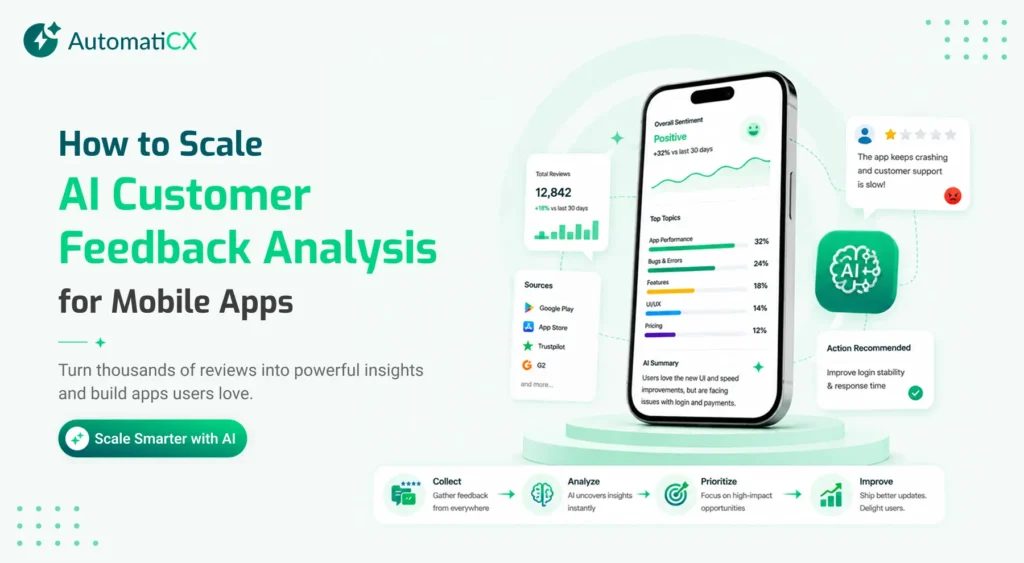
Your team stops looking at thousands of individual reviews. Instead, they look at a simple dashboard that says: “This week, fourteen percent of negative reviews are about the new camera feature, and user sentiment regarding the checkout process has dropped by eight points.”
You have hard facts. You know exactly what is broken. You know exactly what to fix first.
Why This Matters for Your Overall Business Scale
You absolutely cannot grow a digital product if your bucket has holes in it. Pushing thousands of dollars into Facebook or Google advertising is completely useless if your new users download the app, get frustrated by a bug you missed, and leave immediately.
Mastering how you process user feedback is a massive part of overall AI for mobile app growth. When you listen to your users at a massive scale, your product gets better much faster.
When your product gets better, your public star rating goes up. When your star rating goes up, your advertising costs drop because the app stores start giving you free organic traffic. It is a continuous, highly profitable growth loop. But that loop only works if you actually process the text your users leave behind.
Stop Guessing and Start Building
Your users are literally handing you the exact blueprint to improve your app. They are telling you what is broken, what they hate using, and what they are actually willing to pay real money for. If you rely on humans to manually read and sort those messages, you are throwing that valuable blueprint straight in the trash.
It is time to automate your product roadmap.
Stop wasting your valuable hours staring at app store consoles and messy spreadsheets. You can manage all of this automatically with a dedicated AI feedback analytics platform. Let the algorithms do the heavy lifting of reading, sorting, and scoring your user reviews. Let the machines read the text so your team can get back to writing code, building amazing features, and scaling your business.
If you are ready to stop guessing what your users want and start scaling your mobile operations with hard facts, explore our fully automated tracking and growth solutions at AutomaticX AI Services.